
Using a VA Loan to Buy a Home in San Antonio in 2026: What Buyers Need to Know
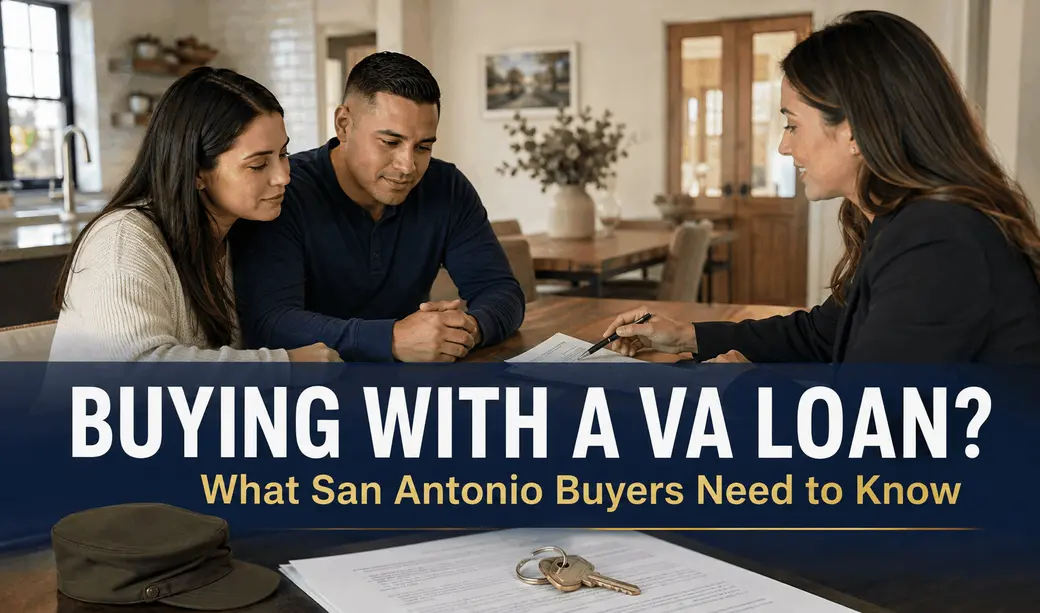
Using a VA Loan to Buy a Home in San Antonio in 2026: What Buyers Need to Know
The VA loan is one of the strongest home-buying benefits available to eligible service members, Veterans and surviving spouses.
It can also be one of the most misunderstood.
People hear “zero down” and assume they won’t need any money. They hear “VA appraisal” and think it replaces an inspection. Some sellers still believe VA loans are harder to close, and plenty of buyers have been told the seller can only contribute 4% toward everything.
None of those explanations tells the whole story.
If you’re buying a home in San Antonio with a VA loan, the loan itself is only one part of the decision. You also need to understand the property, the appraisal, your complete monthly payment, Texas property taxes and how the offer is structured.
Let’s break it down in plain language.
If you’re moving here on military orders, you may also want to start with my complete PCS guide to San Antonio. It compares the housing decisions around Lackland, Randolph and Fort Sam Houston before you begin looking at homes.
What a VA Loan Actually Is
The Department of Veterans Affairs usually isn’t the lender handing you the money.
You apply through a private lender, such as a bank, credit union or mortgage company. The VA guarantees a portion of the loan, which reduces some of the lender’s risk and makes benefits like no required down payment and no monthly private mortgage insurance possible for many eligible borrowers.
According to the VA, a purchase loan may allow an eligible buyer to:
-
Buy with no down payment when the sales price doesn’t exceed the appraised value
-
Avoid monthly private mortgage insurance
-
Buy a single-family home or a property with up to four units
-
Buy a condo in a VA-approved project
-
Build a home or purchase certain manufactured homes
-
Use the benefit more than once
-
Assume an existing VA-backed loan when the requirements are met
But the VA guarantee doesn’t mean every eligible person is automatically approved.
You still need to meet the lender’s requirements for income, credit, debt and the ability to repay the loan. You also need to intend to occupy the home as your residence.
The VA itself doesn’t set one universal minimum credit score, but individual lenders can set their own requirements. That’s one reason it’s worth comparing lenders instead of assuming the first answer you receive is the only answer available.
You can review the basic program directly through the VA’s purchase-loan information.
Start With Your Certificate of Eligibility, but Don’t Stop There
Your Certificate of Eligibility, commonly called a COE, shows a lender that you meet the service-related eligibility requirements for the VA home-loan benefit. It also helps the lender determine whether you have full entitlement, remaining entitlement or a funding-fee exemption shown in VA records.
Many VA lenders can request the COE for you. You can also request it directly through the VA.
But a COE is not a loan approval.
Think of it this way:
-
The COE confirms your eligibility for the benefit
-
The lender determines whether you qualify for the mortgage
-
The appraisal helps determine the property’s reasonable value and whether it meets VA minimum property requirements
All three pieces matter.
If you’ve used a VA loan before, tell the lender early. You may still be able to use the benefit again, even if another VA loan is active, but your remaining entitlement can affect how much you may borrow without a down payment.
Full entitlement also doesn’t mean unlimited buying power. The lender still has to approve the payment, and the home still has to support the price.
The VA explains entitlement in more detail on its home-loan entitlement and limits page.
Zero Down Does Not Mean Zero Cash Needed
This is probably the biggest misunderstanding I hear.
A qualified buyer may be able to finance 100% of the home’s price, as long as the price doesn’t exceed the VA-established value and the borrower has enough entitlement.
That doesn’t mean every other expense disappears.
Depending on the transaction, you may still need money for:
-
Earnest money
-
The option fee in a Texas contract
-
A general home inspection
-
Additional inspections or evaluations
-
The VA appraisal or other lender-required costs
-
Closing costs and prepaid expenses not covered by another party
-
The difference if the price is higher than the appraised value and you choose to continue
-
Moving expenses
-
Repairs, appliances or immediate purchases after closing
-
Emergency savings after you get the keys
Earnest money and the option fee may be credited according to the contract and closing figures, but you still need the funds when they’re due.
Seller credits, lender credits or builder incentives may reduce the amount you bring to closing. Sometimes a well-structured VA purchase can close with very little out of pocket.
But that should be the result of the actual numbers, not an assumption made before the lender prepares an estimate.
I’d rather have a buyer plan for the costs and be pleasantly surprised than arrive at closing short on funds.
Understand the VA Funding Fee
The VA funding fee is a one-time charge applied to many VA-backed loans. It helps support the program because VA loans can offer no required down payment and no monthly mortgage insurance.
For VA purchase and construction loans, the current fee depends on whether you’ve used the benefit before and how much you put down.
For a borrower who isn’t exempt, the VA currently lists these purchase-loan rates:
-
First use with less than 5% down: 2.15% of the loan amount
-
Use after the first time with less than 5% down: 3.3%
-
5% or more down: 1.5%
-
10% or more down: 1.25%
The fee can generally be paid at closing or financed into the loan. A seller, builder, lender or another party may also be able to pay it on the borrower’s behalf within the applicable rules.
Some borrowers are exempt. The VA lists several qualifying situations, including certain borrowers receiving or entitled to receive VA compensation for a service-connected disability, certain surviving spouses receiving Dependency and Indemnity Compensation, and qualifying active-duty Purple Heart recipients who provide the required evidence by closing.
Your lender should verify the status shown through the VA. Don’t assume you’re exempt based only on a pending claim or a verbal answer.
The current percentages and exemptions are listed on the VA’s funding-fee and closing-cost page.
The 4% Seller-Concession Rule Is Often Explained Wrong
You may have heard that a seller can only pay 4% of a VA buyer’s closing costs.
That’s not how the VA currently explains the rule.
The VA says it doesn’t limit credits used for ordinary loan closing costs. It does limit seller concessions to no more than 4% of the home’s reasonable value shown in the VA Notice of Value.
Those aren’t the same category.
Ordinary closing-cost credits may help cover items such as:
-
The loan-origination fee
-
Discount points
-
The VA appraisal
-
Title-related charges
-
Recording fees
-
Certain taxes and insurance costs
-
Buyer-broker charges when structured and permitted under current VA rules
The separate 4% concession limit applies to certain added benefits, such as payment of the VA funding fee, payoff of some buyer debts or judgments, prepaid hazard insurance and a temporary rate buydown funded by the seller or builder.
The exact treatment depends on what’s being paid and how it appears in the loan. Your lender needs to review the complete offer before anyone promises that a credit will work.
This matters in San Antonio because builder and seller incentives can look generous on an advertisement. The important question isn’t only how large the incentive is.
It’s whether the credit is allowed, how it will be applied and whether you’ll actually be able to use all of it.
A VA Appraisal Is Not a Home Inspection
I’ll say this as clearly as I can:
Get the inspection.
The VA appraisal serves two main purposes. The appraiser provides an opinion of the home’s value and reviews the property for VA minimum property requirements.
The basic goal is a property that is safe, structurally sound and sanitary.
The appraisal is not a detailed investigation of every system in the house. The appraiser isn’t performing the same job as a Texas-licensed home inspector, plumber, electrician, structural engineer, roofer or HVAC technician.
A home inspector may identify concerns involving:
-
The roof
-
Foundation movement and drainage
-
Plumbing and sewer lines
-
Electrical panels and wiring
-
HVAC equipment and ductwork
-
Water heaters
-
Windows and moisture intrusion
-
Appliances
-
Previous additions or remodeling
-
Wood-destroying insects
Some findings may lead you to request a specialist evaluation.
San Antonio has everything from older central-city homes to brand-new construction. The inspection needs can be very different, but “new” doesn’t mean “perfect.” I recommend an independent inspection on new construction too.
The VA updated portions of its minimum property requirements in June 2026, including guidance involving older paint, radon and certain heaters. That’s another reason not to rely on a friend’s old story about what a VA appraiser will automatically require.
The core question is the actual property in front of us and the current guidance your lender and appraiser must follow. You can read the VA’s 2026 appraisal update and its explanation of the VA home-buying process.
What Happens if the VA Appraisal Comes in Low?
If the VA-established value is below the contract price, it doesn’t automatically mean the deal is over.
You may have several options:
-
Request a Reconsideration of Value using relevant market evidence
-
Renegotiate the purchase price
-
Ask whether the seller will make another adjustment to the deal
-
Pay the difference in cash if you’re willing and able
-
Use the VA escape clause and choose not to complete the purchase
The VA escape clause is an important protection. In general, it prevents a VA buyer from being forced to complete the purchase or lose earnest money solely because the contract price exceeds the VA-established reasonable value.
It doesn’t reimburse every expense you’ve already paid. Inspection fees, appraisal costs and some new-construction upgrade deposits may still be at risk depending on the contract and circumstances.
Value also isn’t the only appraisal concern. If the appraiser identifies a property-condition issue that must be corrected, the repair may need to be completed and verified before the loan can close.
That’s why the home, the seller’s willingness to cooperate and the time available before closing all matter when we write the offer.
The VA explains the protection and the buyer’s options on its VA escape-clause page.
Texas Property Taxes Can Change the Payment More Than Buyers Expect
Texas doesn’t have a state individual income tax, but property taxes can be a major part of the monthly housing payment.
Two San Antonio-area homes with the same price and interest rate can have noticeably different payments because they’re in different cities, school districts or special taxing districts.
Before you fall in love with the builder’s advertised payment, check:
-
The estimated tax rate for the exact property
-
Whether the current tax bill reflects the completed home
-
Whether the property is inside a municipal utility district or another special district
-
The homeowner’s-insurance estimate
-
HOA dues
-
Whether the lender used realistic taxes in the payment
-
Which homestead or disabled-veteran exemptions may apply
This is especially important with new construction. A current tax record may reflect only the land or a partially completed home. Your future escrow payment may be based on a much higher completed value.
Texas offers several disabled-veteran property-tax exemptions. One of the most significant is a total exemption of the appraised value of a qualifying Veteran’s residence homestead when the Veteran receives 100% disability compensation due to a service-connected disability and has a 100% disability rating or a qualifying determination of individual unemployability.
Other disabled Veterans may qualify for partial exemptions.
These exemptions aren’t automatic. They require an application through the local appraisal district, and the timing can affect how the lender handles the estimated payment and escrow account. Verify the exemption with the appraisal district and your lender before building your budget around it.
You can read more in my San Antonio property-tax guide and verify the exemption rules through the Texas Comptroller.
Buying New Construction With a VA Loan
VA financing can work well with new construction, especially when a builder is offering closing-cost assistance or an interest-rate incentive.
Just compare the entire deal.
Look at:
-
The base price and the final price with upgrades
-
Whether the advertised rate is fixed, temporary or tied to a preferred lender
-
The payment after any temporary buydown ends
-
The completed-home tax estimate
-
HOA and special-district taxes
-
Lot premiums
-
Inspection access during construction
-
The builder’s repair and warranty process
-
Resale competition from future builder inventory
-
The commute you’ll actually drive
A temporary buydown can make the first year or two easier, but the lender must qualify you using the full payment due after the buydown period ends. Builder- or seller-funded temporary buydowns also count toward the VA’s 4% seller-concession limit.
And remember, the salesperson in the model home represents the builder.
If you want your own Realtor involved, bring that agent into the conversation before you register, tour repeatedly or begin negotiating directly with the builder.
I compare the tradeoffs in more detail in my guide to new construction versus resale homes in San Antonio.
VA Loan Assumptions Can Be Valuable, but They Aren’t Automatic
An existing VA loan may be assumable by a qualified buyer. That can be attractive when the loan’s interest rate is lower than current market rates.
But an assumption isn’t as simple as taking over the seller’s payment.
The loan servicer, and in some cases the VA, must approve the assumption. The buyer will generally be reviewed for credit and income. The buyer also needs a plan for the difference between the remaining loan balance and the seller’s price.
That equity gap may require cash or approved secondary financing.
There’s also an important issue for the seller. If the person assuming the loan doesn’t substitute enough of their own VA entitlement, the original borrower’s entitlement can remain tied to the loan.
So yes, an assumption can create a great opportunity.
It can also take longer, require more cash and affect the Veteran seller long after the closing if it isn’t handled correctly.
This needs to be evaluated with the loan servicer before the buyer and seller build their entire plan around the rate.
Why Some VA Offers Run Into Trouble
VA buyers aren’t weak buyers.
But a poorly prepared VA offer can create problems that should’ve been caught earlier.
Common issues include:
-
The buyer has a COE but hasn’t completed a solid lender preapproval
-
The lender isn’t experienced with VA purchases
-
The buyer’s remaining entitlement wasn’t reviewed
-
The estimated payment uses unrealistic property taxes or insurance
-
The property condition is unlikely to meet VA requirements without repairs
-
The condo project isn’t VA approved
-
The appraisal comes in below the contract price
-
The seller won’t complete a required repair
-
The buyer opens new credit, changes jobs or moves money without talking to the lender
-
The closing date doesn’t leave enough room for the appraisal, repairs or military travel
-
A builder incentive sounds great but can’t be used the way the buyer expected
Most of these aren’t reasons to avoid a VA loan.
They’re reasons to have the right people involved before the offer is written.
What to Do Before You Start Touring Homes
Before we begin looking, I recommend that you:
-
Talk with a lender who regularly closes VA purchase loans.
-
Have the lender obtain and review your COE and entitlement.
-
Ask whether the funding fee applies to you.
-
Review the complete estimated payment, including taxes, insurance and HOA dues.
-
Decide how much cash you’re comfortable using for inspections, closing and moving.
-
Avoid opening new credit or making large financial changes without speaking to the lender.
-
Tell me your work location, commute limit and housing priorities.
-
Compare new construction and resale based on the full deal, not just the advertised rate.
If you’re PCSing, the assigned installation should help shape the search. I’ve built separate local guides for buyers moving near JBSA-Lackland, JBSA-Randolph and Fort Sam Houston or BAMC.
If one of those articles isn’t live yet, send me the installation directly and I’ll help you compare the areas.
Planning to Use a VA Loan in San Antonio?
I’m Steven Hernandez, a San Antonio Realtor, Military Relocation Professional and member of Real Military. I help service members and Veterans compare homes, understand the complete monthly payment, evaluate builder incentives and work through the details that can make or break a VA purchase.
If you’re planning to buy in San Antonio or the surrounding area, call or text me at 210-861-6686.
You don’t need to know every VA rule before we talk.
That’s what your lender and I are here to help you work through.
Categories
Recent Posts





“My job is to find and attract mastery-based agents to the office, protect the culture, and make sure everyone is happy! ”