
PCSing to JBSA-Fort Sam Houston in 2026: Where to Live Near Fort Sam Houston
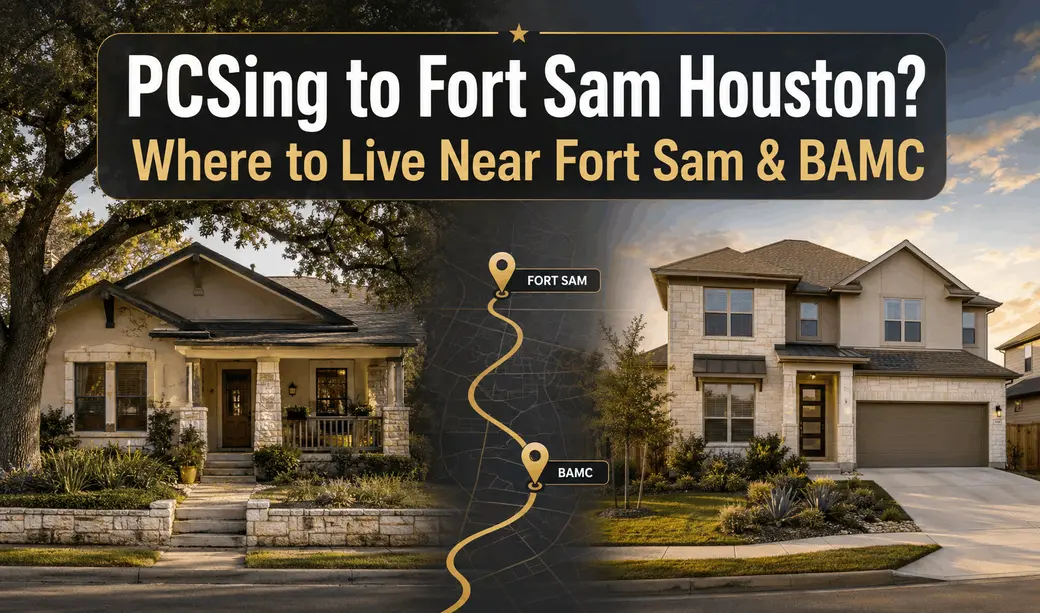
Where to Live Near Fort Sam Houston
If you’re PCSing to Fort Sam Houston, don’t begin your home search by asking which neighborhood is closest to the words “Fort Sam Houston” on a map.
Start with where you’ll actually report.
That matters more here than most people realize.
Fort Sam Houston covers a large area, and Brooke Army Medical Center sits on the other side of Interstate 35 from much of the main post. Two service members can both say they’re assigned to Fort Sam and still need completely different routes, gates and home searches.
One may care most about getting to BAMC. Another may report closer to Walters Street, New Braunfels Avenue or the center of the installation. A spouse may work downtown, at Lackland, in Stone Oak or on the other side of San Antonio.
That’s why there isn’t one “best” place to live near Fort Sam.
The right answer comes down to your actual work location, the home you need, the payment you’re comfortable with and how much driving you’re willing to do every day.
If you’re comparing more than one JBSA installation, begin with my complete PCS guide to San Antonio. You can also use my Moving to San Antonio relocation guide to get a better feel for the city as a whole.
Fort Sam Houston Is Not One Commute
Before we talk about areas, find out where you’re expected to report and which gate normally makes sense for that location.
The difference between the main post and the BAMC side can completely change the drive. A house may look close on a map but require you to cross I-35, work through an interchange or approach from the wrong side of the installation.
That doesn’t mean you should choose a home based on one gate alone. Gate hours and access can change because of holidays, construction, staffing or security needs.
It does mean we should know:
-
Your unit, building or work location
-
Whether you’ll report to the main post, BAMC or another JBSA location
-
Your normal report time
-
Which gates are open during that commute
-
Whether your spouse or partner has a separate commute
-
How much driving you’re willing to accept
JBSA publishes its current Fort Sam Houston gate hours and access information. Check it before testing a route or making a housing decision.
Then test the commute when you’d actually drive it.
A route that looks easy on Sunday afternoon can feel completely different at 6:30 on a weekday morning.
Area 1: Government Hill, Westfort and Homes Closest to the Main Post
If your priority is living close to the main post, Government Hill and the small neighborhoods around the installation are natural places to begin.
This part of San Antonio has older homes, renovated properties, townhomes, smaller lots and new infill mixed together. You may also see homes near the Pearl, Dignowity Hill and other close-in neighborhoods depending on your budget and the route you need.
The biggest benefit is location.
You may be able to reduce the distance to work while staying near downtown, the Pearl, Broadway and central San Antonio. That can also help when two people in the household need access to different parts of the city.
But close doesn’t automatically mean simple.
Homes in this part of town can vary widely from one block to the next. Two houses with similar square footage may have completely different renovation histories, foundation conditions, plumbing, electrical systems and parking.
When we look at an older or remodeled home, I want to know:
-
What work was completed and whether permits were required
-
The age and condition of the roof and HVAC system
-
Whether the plumbing has been updated
-
What kind of electrical panel and wiring the home has
-
Whether additions or converted spaces appear properly completed
-
How drainage moves around the house
-
Whether parking, alley access and street traffic fit your daily routine
A beautiful kitchen doesn’t tell us what’s under the house or behind the walls.
That’s why the inspection and repair history matter just as much as the finishes.
Area 2: Mahncke Park, Terrell Heights and the Central Northeast Side
If you want to remain fairly central but prefer a different housing mix, the search may move north or northeast of Fort Sam.
Depending on your price range and priorities, that can include:
-
Mahncke Park
-
Terrell Heights
-
Oak Park-Northwood
-
Wilshire
-
Parts of Alamo Heights and Terrell Hills
-
Other neighborhoods near Harry Wurzbach Road and Austin Highway
These areas can offer access to the main post, the BAMC side and central San Antonio without pushing the search all the way out toward Loop 1604.
You’ll find a wide mix of housing. Some neighborhoods have older cottages and bungalows. Others have mid-century homes, remodeled properties, townhomes or newer infill.
The tradeoff is usually price, size and condition.
You may pay more for location while getting less square footage or a smaller lot than you’d find farther northeast. An older home may also need more maintenance, even if it has already been updated.
Another thing people miss is that the city name can change quickly in this part of the market. San Antonio, Alamo Heights and Terrell Hills are separate municipalities. Tax rates, utilities, permits and city services can differ even when two homes are only a short distance apart.
We need to check the exact property, not make assumptions based on the neighborhood name in an online listing.
Area 3: Windcrest, Kirby, Converse and Northeast San Antonio
Moving farther east or northeast can open up more choices in both price and home style.
Common search areas may include:
-
Windcrest
-
Kirby
-
Converse
-
Northeast San Antonio
-
Neighborhoods near Interstate 35, Interstate 410, FM 78 and Binz-Engleman Road
This zone has a broad mix of homes. You may find established neighborhoods with larger yards, updated resale homes, newer subdivisions and some new construction.
For many buyers, this is where the search becomes a balance between house and drive.
You may get an extra bedroom, more yard or a newer home than you’d find closer to the center of the city. But the route into Fort Sam or BAMC may depend heavily on I-35, I-410 or surface streets that get busy during commuting hours.
Railroad crossings can also affect certain routes near FM 78. That won’t matter for every property, but it’s worth testing if your normal drive would cross the tracks.
This is another area where boundaries deserve attention. A listing may use “San Antonio” in the marketing while the property is actually inside Kirby, Windcrest or Converse. Verify the city, school district, utility providers, tax entities and any HOA for the exact address.
Area 4: Live Oak, Universal City, Schertz and Farther Northeast
Some Fort Sam buyers continue up the I-35 corridor into Live Oak, Universal City, Schertz or even Cibolo.
Why?
The home choices can be very different.
These areas may offer larger subdivisions, newer construction, more recent resale homes and floor plans with additional bedrooms or living space. If one person works at Fort Sam and another works near Randolph, this part of the corridor may also be worth comparing.
The tradeoff is the commute.
Interstate 35 is already one of the busiest corridors in the area, and major expansion work is underway. TxDOT lists the I-35 project from North Walters Street to I-410 South on a 2026 through 2029 timeline. Other Northeast Expansion projects extend farther up the corridor, with construction and traffic changes continuing through 2027 and 2028.
Construction schedules can change, but the practical point is simple.
Don’t judge this drive from the mileage alone.
Test the route during your actual commuting window, pay attention to alternate routes and decide how much time you’re willing to trade for the house.
The right house can lose its shine pretty quickly if you resent the drive every morning and evening.
You can review current project and closure information through TxDOT’s I-35 Northeast Expansion page and its San Antonio construction project list.
Older Homes Need a Different Kind of Due Diligence
One of the biggest differences between Fort Sam and the outer parts of San Antonio is the age of the housing stock.
Buying an older home isn’t a bad decision. Plenty of buyers prefer the location, architecture and established feel of these neighborhoods.
You just need to inspect the right things.
Depending on the home’s age and renovation history, that may include:
-
Foundation movement and drainage
-
Cast-iron or older sewer lines
-
Supply plumbing materials
-
Electrical panels, wiring and available service
-
Roof age and prior repairs
-
HVAC age, ductwork and insulation
-
Windows and signs of moisture intrusion
-
Additions, garage conversions and previous remodeling
-
Termite or other wood-destroying insect activity
For some homes, a general inspection isn’t enough. A sewer scope, foundation evaluation, HVAC review or other specialist inspection may be worth the additional cost when the initial findings call for it.
If you’re using a VA loan, remember that the VA appraisal is not a home inspection. The appraiser evaluates value and the VA’s minimum property requirements. Your inspector is looking more deeply at the condition of the home and helping you understand what you may be taking on.
The VA itself recommends a home inspection and makes clear that an appraisal and an inspection are not the same thing.
Check for Historic or Conservation-District Rules Before You Renovate
Some close-in properties are inside a local historic district, conservation district or another area with additional design rules.
That can matter if you plan to replace windows, change the exterior, build an addition, add a casita, replace certain materials or make other visible improvements.
For properties with a historic zoning overlay, the City of San Antonio says exterior modifications and repairs require a Certificate of Appropriateness. Some requests can be handled by city staff, while others may need review by the Historic and Design Review Commission.
That doesn’t mean you shouldn’t buy the house.
It means you need to know the rules before you build your renovation budget around something you may not be allowed to do exactly the way you planned.
You can review the current process through the City of San Antonio’s Office of Historic Preservation.
Property Taxes Can Change From One Area to the Next
The Fort Sam search can cross several cities, school districts and special taxing areas without going very far geographically.
Two homes with the same price can have different estimated monthly payments because the total tax rate and exemptions are different.
Before you compare homes, we should look at:
-
The current assessed value
-
The estimated value after a sale or new construction is completed
-
The total tax rate for the specific property
-
Whether the home is inside San Antonio or another municipality
-
The homestead exemption
-
Any disabled-veteran exemption you may qualify for
-
How the lender estimated taxes in the monthly payment
Don’t rely only on the current owner’s tax bill. Their exemptions, assessed value and ownership history may not match yours.
I break this down in more detail in my San Antonio property-tax guide.
Should You Buy or Rent Near Fort Sam Houston?
Buying may make sense if you expect to remain in San Antonio for several years, the payment is comfortable and the home fits both your current needs and a realistic exit plan.
Renting first may make more sense if:
-
You don’t know your exact work location yet
-
Your orders or assignment could change
-
You need to learn the commute before choosing an area
-
You’re unsure whether your household needs access to more than one installation
-
Buying would use most of your emergency savings
-
You want time to compare older homes with newer options farther out
There’s nothing wrong with renting for a while if it helps you avoid buying in the wrong location.
Sometimes six months of learning the city is worth more than rushing into a house because the report date is getting close.
Can You Buy Before You Arrive in San Antonio?
Yes. Much of the process can be handled remotely.
I can help with:
-
Live video tours
-
Honest views of the street and surrounding properties
-
Route and neighborhood drive-throughs
-
Electronic documents and signatures
-
Inspection coordination
-
Video attendance during the inspection when practical
-
Communication with your lender and title company
-
Remote or mobile closing options when available
But a remote tour should show you more than the good parts.
You need to see the traffic behind the house, the parking situation, the cracked driveway, the older electrical panel and the room that feels much smaller than it looked in the photos.
I’d rather point out a problem while you’re watching on your phone than have you find it while unloading the moving truck.
What to Send Me Before We Start Looking
If you’re preparing for a PCS to Fort Sam Houston, send me:
-
Your unit, building or exact work location if known
-
Whether you’ll report to the main post, BAMC or another location
-
Your report-no-later-than date
-
Your expected arrival date
-
Your desired monthly payment
-
Your maximum comfortable commute
-
The number of bedrooms and bathrooms you need
-
Whether you’re buying, renting or comparing both
-
Whether you prefer an older central home, newer construction or either
-
Your pets, accessibility needs and other major housing priorities
-
Whether another person in the household has a separate commute
From there, I can narrow the search around your actual day-to-day life.
Not a random list of neighborhoods.
Not the pin in the middle of the base.
Your work location, your payment and your priorities.
Planning a PCS to Fort Sam Houston?
I’m Steven Hernandez, a San Antonio Realtor and Military Relocation Professional. I help military families and veterans compare areas, understand VA financing, evaluate older homes and new construction, and make sense of the complete monthly payment before choosing a property.
If you’re moving to Fort Sam Houston or BAMC, call or text me at 210-861-6686.
You don’t need to know exactly where you want to live yet.
That’s what we’ll figure out together.
Categories
Recent Posts







“My job is to find and attract mastery-based agents to the office, protect the culture, and make sure everyone is happy! ”